- 1066-1087 the Normans invade England and build castles
- 1086 the Doomsday book is written. It is a list of everything in England at the time
- 1087-1100 William Rufus invades Wales and builds castles on the borders
- 1100-1135 William's brother Henry becomes king
- 1135-1154 The reign of King Stephen (nephew of Henry I)
- 1099: First crusade urged by Pope Urban II
- 1118: The Knights Templar founded to protect Jerusalem and European pilgrims on their journey to the city
- 1147: The second Crusade begins
- 1184: The Inquisition begins. This was when the Church became interrogating and converting Jews and heretics. It becomes infamous in Spain. They are tortured there.
- King Richard I is Richard the Lionhearted and died during the Third Crusade in 1190
- 1199: King John. He was not liked. Starts the Fourth Crusade
- 1212: Children's Crusade. They sent children to fight for them
- 1214-1215: The Barons revolt demanding that the King take responsibility forcing him to sing the Magna Carta. It was written in 1215. It forced King John to accept that the monarch had to play by the rule of law. Until now the King was above the law. This is considered the founding of the Constitutional Democracy
- Provisions of Oxford (1258) made King Henry III choose a new form of government. The authorities are being weaker
- Rudolph I is elected Holy Roman Emperor in 1273. This area is Germany, some of Italy, and some of Switzerland.
- Summa Theologiae is a book of systematized theology. It becomes the most important work of theology of the Middle Ages
- The Knights Templar of killed by Philip the Fair of France, supported by the Pope
- Things get worse after the Great Famine
- the Hundred Years War starts in 1337 between the House of Valois and the House of Plantagenet. It causes nationalization in France and Europe. Italy remains in City-States. England and France become stronger than Italy. Everyone in Italy pays taxes to the Pope. This gives the Pope strength. It is broken down into three parts: the Edwardian War (1337-1360), the Caroline War (1369-1389), and the Lancastrian War (1415-1429)
- 1380: Chaucer begins to write The Canterbury Tales. It is considered one the greatest works of poetry in the Middle Ages.
- 1382: The Bible is translated into English. It took 300 years to do this
- King Henry the V is considered one of the greatest Kings in English history.
- 1415: Defeat the French at Agincourt. Greatest defeat that they suffer
Wednesday, April 28, 2010
Notes Medieval Ages

Monday, April 26, 2010
Notes The Crusades
- The first Crusade was a failure
- There are multiple changes back in Europe
- France becomes the kingdom of France
- The Capetians unite the French
- In England the Normans invade
- Until the rise of the Stewart Kings, England is ruled by French Families
- France is becoming powerful because of the ties between the Capetians and the Church
- There is a lot of French art in Gothic Architecture in England
- Spain was taken over by the Moores. They ruled for 700 years
- When Islam spreads in the 7th century, Constantinople is taken over by the Muslims and becomes Istanbul.
- The Library of Alexandria is burned down
- The mistake from the first crusade was their goal. They made Jerusalem an unnecessary enemy.
- the French have a crusade into Moorish Spain
- They are surprised to found out that it is a thriving civilization
- Aristotle said that logic defeats superstition
Friday, April 23, 2010
Article 9
There are social orders in every society, and they cannot be avoided. They are good for people in the upper portions of the social classes. They are bad for the people in the lower portions of the social classes. Many times, social orders are described as being in a pyramid. Social orders don’t allow any movement between them. When it is possible, it is extremely difficult. For example, in medieval times, there were three major social classes, serfs, clergy, and the noblemen.
The serfs and pheasants were at the very bottom in the social orders. If you were born in that social class, you died in that class. It was virtually impossible to change classes. This class made up the majority of the population in medieval Europe. They also did the majority of the work. They were almost treated as slaves. Living life as a pheasant was not enjoyable. There were multiple instances where the serfs and pheasants rose up and decided to rebel against the noblemen. Because the serfs were poor, they did not stand much a chance. They were quickly put back in their place. The serfs made up the large, bottom of the pyramid.
The middle portion of the social order contains the clergy. The clergy is anyone that is involved in church duties, such as bishops, priests, monks, or the Pope. They lived a better life than the serfs and pheasants, but it was not as enjoyable as the noblemen’s lifestyle. The job of the clergy was to copy the text and music found in the Bible, but most of their time was spent praying. The rest of their time was devoted to taking care of monastery gardens. The clergy made up the middle part of the social class pyramid.
The top, and least populated, section of the pyramid would consist of the noblemen. These were the rich, landowning people of the time. A nobleman’s life was fairly easy compared to the harsh treatment of pheasants. They were the ones who owned the farms and the serfs that farmed the land. Only a very slim portion of the population would be in this class. The wealth in medieval Europe was contained only between the Catholic Church and the noblemen. Because pheasants did not have any money, it made virtually impossible to move up in the pyramid. No matter how hard they worked, their pay was almost nothing.
In the time period discussed, medieval times, it was extremely difficult and nearly impossible to rise in social class. If you are born into a certain class then that is where you stay. This is bad because it does not give much incentive to work hard, because there would be no reward.
Thursday, April 22, 2010
Daily
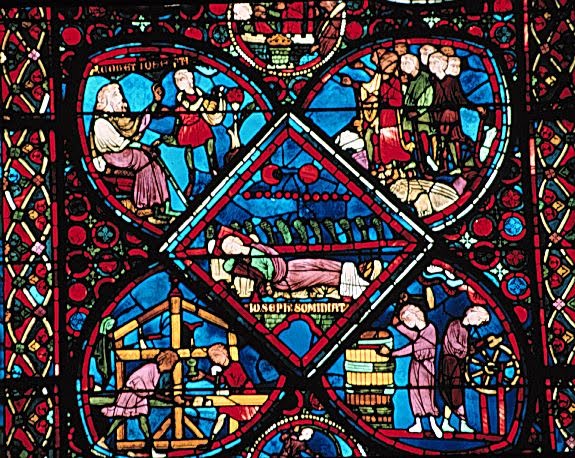
Did Gothic architecture reflect a change in Church theology?
The Gothic style of architecture showed the change in the Church's theology. Before Gothic, Romanesque architecture was a prevalent style in Church buildings. The Romanesque style showcased Judgment Day, Hell, and the darker side of the religion. Gothic architecture was more about hope and light and the brighter side of Catholicism. The new style showed that the Church changed its way of belief from a sadder and darker way of thinking, to a more pleasant and enjoyable way of thinking.
Wednesday, April 21, 2010
Required Daily
In a town named Bel Air, in the year of 2010, a serious disease called Koza swept through the city. This disease caused whoever was infected with it to turn into a goat. In Bel Air there was a boy named Steven. He had a sister, a mom, a dad, and plenty of friends. He had known of a few people that had gotten Koza, but wasn't affected by it too much. A couple days later, one of his close friends got sick with it. This worried Steven because his friend was at his house the day before he fell sick. About a week later, Steven walked into his sister's room only to find her with horns and fur! He immediately ran into his parent's room to get their help. It was too late. His parents had contracted Koza as well. Steven had no other choice but to run away. Unfortunately for Steven, Koza had already spread to the surrounding cities. He had no where to go. He was stuck on an earth with only goats.
Notes on Bubonic Plague
Events that took place in 1348-1350
The Black Death
- Carried by rats and fleas
- spread rapidly
- rats traveled on merchant ships. this aided the spread of the disease
- it was another disaster in a series of bad things to happen to europe
- if you came into contact with someone who died of the black plague, you would soon follow them
- blisters and boils appeared on the body of a person with the disease.
- took three days to die of it
- thought it was the end of the world because of all of the sin
- hundred of people died every day
- bodied were buried hundreds at a time
- few who caught the disease lived
- They thought that the air needed to be cleansed by lighting fires
- Most doctors could not help patients
- One doctor tried to cure himself with much success
- Two kinds of the plague. One was more deadly than the other
- the rich ran away from the plague
- It would move through Europe relatively quickly
- It killed a third of Europe's population
- the cause was the fleas that transmitted the disease from rats to humans
- It returned every few decades until the 1700
- Caused a moment of less belief in the church as an institution
Monday, April 19, 2010
Revised Daily

How was the Medieval concept of power and equality different from our contemporary concept?
The Medieval concept of power and equality was drastically different from our modern beliefs on equality. In their society, it was nearly impossible to rise out of serfdom and into a higher social class. The serfs in the Medieval ages were treated very poorly. The Council of Worms said "If any woman incensed by a fit of jealousy should beat her slave, so that within three days she [the slave] should die in torment" (Council of Worms). This shows the little worth that a slave had compared to their owners. Religion played a role in this. One law said "Jews should not be allowed to have Christian slaves nor to buy Christian slaves, nor to obtain them by the kindness of any one; for it is not right that the members of Christ should serve the ministers of Anti-Christ. But if henceforward Jews presume to have Christian slaves or handmaidens they shall be taken from their domination and shall go free" (Fourth Council of Toledo).
In modern society, if anyone is killed then the murder is punished. Also, no one is restricted from anything based on their religion. The Fifteenth Amendment in the Constitution of the United States says "the right of citizens of the United States to vote shall not be denied or abridged by the United States or by any State on account of race, color, or previous condition of servitude," (The Constitution). This means that no one will be denied the right to vote based on the color of their skin or their race. Contemporary views see everyone as being equal, while back in Medieval times, the serfs were treated with much less respect than their owners. It is also not as difficult to rise in social classes. In America, if a person works hard, then he or she will eventually be rewarded with money or a promotion.
"Medieval Sourcebook: Fourth Council of Toledo: On the Keeping of Slaves, 633." FORDHAM.EDU. Web. 14 Apr.
2010. .
"Medieval Sourcebook: Council of Worms: On the Murder of Slaves, 876." FORDHAM.EDU. Web. 14 Apr. 2010.
"The United States Constitution - The U.S. Constitution Online - USConstitution.net." Index Page - The U.S. Constitution Online - USConstitution.net. Web. 19 Apr. 2010. .
Subscribe to:
Posts (Atom)